- Conditions actuelles
- Direct station VP2
- jauges station VP2
- Statistiques NOAA VP2

- Relevés station WU
- Relevés station AWEKAS
- console
- Stations Météo voisines
- Prévisions

- Précipitations
- Yr-No radar
- Avertissements
- Vent
- Sun/Moon/Earth
- Personnaliser
- Configure
- More radar / maps
- More advisories
- More Forecasts
- Hhistory / almanac
- Steelseries
- Mesonet
- D'autres questions
- Développement
- relevés de la station
- Inspect uploads & settings
Visitez nos sites météorologiques autres:
Template documentation
and downloads
Vous trouverez notre info météo Également à:




Space Weather Observations, Alerts, and Forecast
Forecast text
Product: 3-Day Forecast
- Issued: 2026 Oct 28 0030 UTC
Prepared by the U.S. Dept. of Commerce, NOAA, Space Weather Prediction Center.
Geomagnetic Activity Observation and Forecast
The greatest observed 3 hr Kp over the past 24 hours was 3 (below NOAA
Scale levels).
The greatest expected 3 hr Kp for Oct 28-Oct 30 2026 is 2.33 (below NOAA
Scale levels).
NOAA Kp index breakdown Oct 28-Oct 30 2026
| Oct 28 | Oct 29 | Oct 30 | |
|---|---|---|---|
| 00-03UT | 1.33 | 1.67 | 2.33 |
| 03-06UT | 1.33 | 1.33 | 2.33 |
| 06-09UT | 1.00 | 1.33 | 2.33 |
| 09-12UT | 1.00 | 1.33 | 2.00 |
| 12-15UT | 0.67 | 1.33 | 2.00 |
| 15-18UT | 1.33 | 1.33 | 2.00 |
| 18-21UT | 1.67 | 1.67 | 1.67 |
| 21-00UT | 1.67 | 1.67 | 2.00 |
Rationale: No G1 (Minor) or greater geomagnetic storms are expected. No significant transient or recurrent solar wind features are forecast.
Solar Radiation Activity Observation
Solar radiation, as observed by NOAA GOES-18 over the past 24 hours, was below S-scale storm level thresholds.
Solar Radiation Storm Forecast for Oct 28-Oct 30 2026
| Oct 28 | Oct 29 | Oct 30 | |
|---|---|---|---|
| S1 or greater | 1% | 1% | 1% |
Rationale: No S1 (Minor) or greater solar radiation storms are expected. No significant active region activity favorable for radiation storm production is forecast.
Radio Blackout Activity
No radio blackouts were observed over the past 24 hours.
Radio Blackout Forecast for Oct 28-Oct 30 2026
| Oct 28 | Oct 29 | Oct 30 | |
|---|---|---|---|
| R1-R2 | 5% | 5% | 5% |
| R3 or greater | 1% | 1% | 1% |
Rationale: No R1 (Minor) or greater radio blackouts are expected. No significant active region flare activity is forecast.
Sun Images
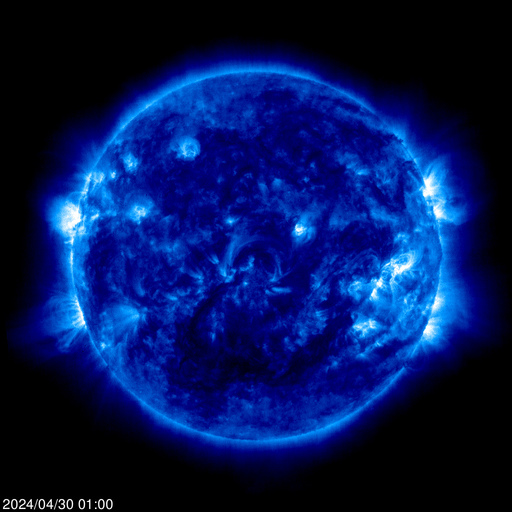
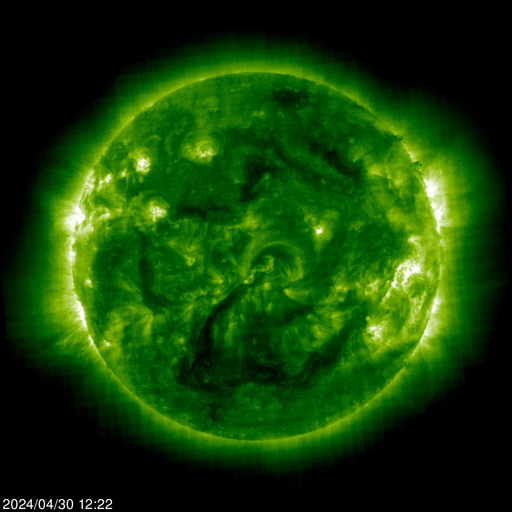
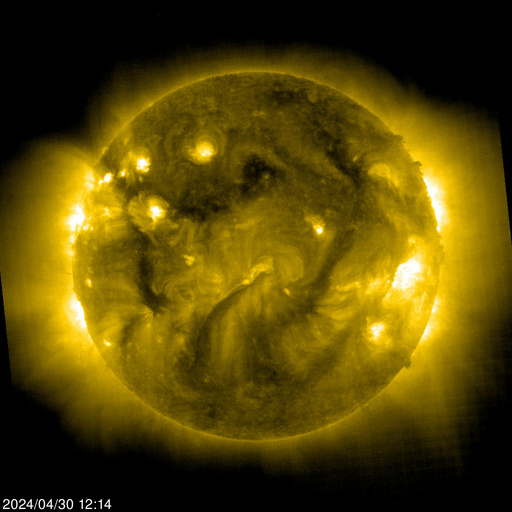
| eit 171 | eit 195 | eit 284 | eit 304 |
 |
 |
 |
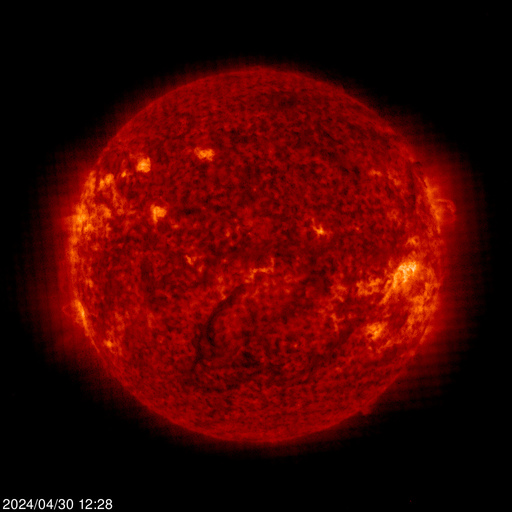 |
Images: From left to right: EIT 171, EIT 195, EIT 284, EIT 304 EIT (Extreme ultraviolet Imaging Telescope) images the solar atmosphere at several wavelengths, and therefore, shows solar material at different temperatures. In the images taken at 304 Angstrom the bright material is at 60,000 to 80,000 degrees Kelvin. In those taken at 171 Angstrom, at 1 million degrees. 195 Angstrom images correspond to about 1.5 million Kelvin, 284 Angstrom to 2 million degrees. The hotter the temperature, the higher you look in the solar atmosphere. | |||
| SDO/HMI Continuum |
SDO/HMI Magnetogram |
LASCO C2 | LASCO C3 |
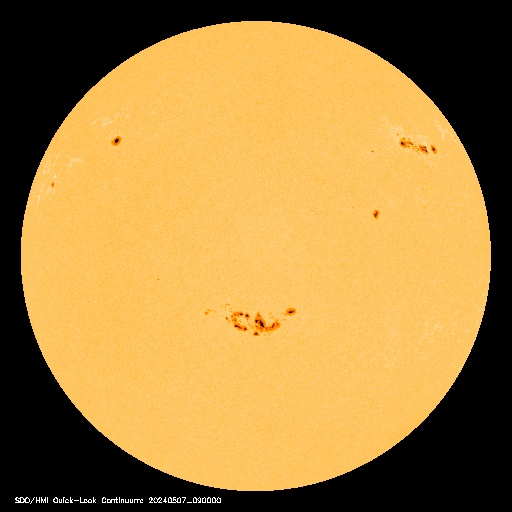 |
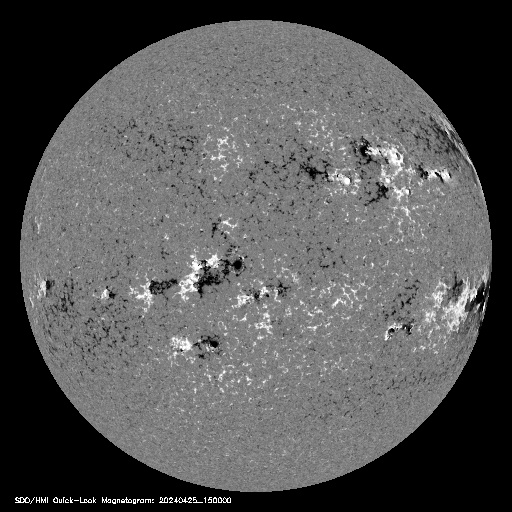 |
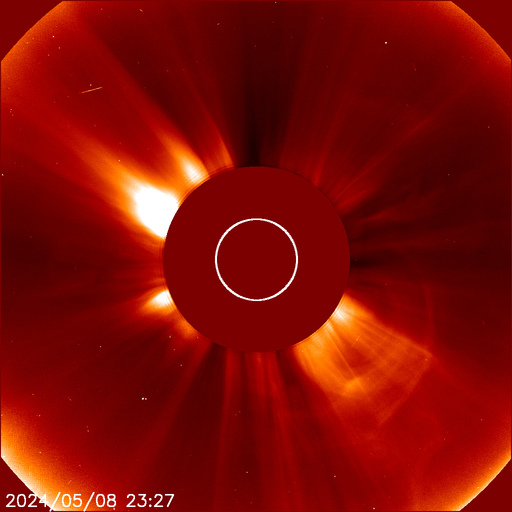 |
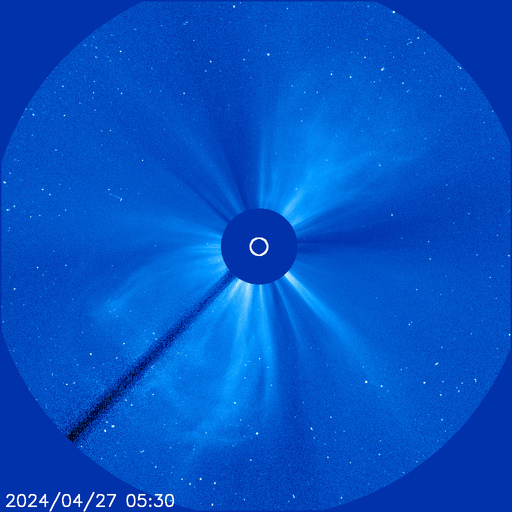 |
The MDI (Michelson Doppler Imager) images shown here are taken in the continuum near the Ni I 6768 Angstrom line.
The most prominent features are the sun spots. |
LASCO (Large Angle Spectrometric Coronagraph) is able to take images of the solar corona by blocking the light coming directly from the Sun with an occulter disk, creating an artificial eclipse within the instrument itself. |
||
 for more information for more information | |||
Bigger versions of this page in a new window: New regular size page, New 1280×1024 window, and New 1600×1200 window. |
|||
Solar cycle
| Sunspot numbers | F10.7CM Radio flux | AP |
 |
 |
 |
| for more information | ||
The Solar Cycle is observed by counting the frequency and placement of sunspots visible on the Sun. Solar minimum occurred in December, 2008. Solar maximum in May, 2013. | ||
| Solar wind | Satellite impact | Xray flux |
 |
 |
 |
| for more information | for more information | for more information |
On the left: Real-Time Solar Wind data broadcast from NASA's ACE satellite. Middle: The Satellite Environment Plot combines satellite and ground-based data to provide an overview of the current geosynchronous satellite environment. Right: 3-days of 5-minute solar x-ray flux values measured on the SWPC primary and secondary GOES satellites. | ||
Auroral activity
| Northern Auroral map | Southern Auroral map |
 |
 |
Introduction Movie
Conditions on the Sun and in the solar wind, magnetosphere, ionosphere and thermosphere that can influence the performance and reliability of space-borne and ground-based technological systems and can endanger human life or health. This introduction movie in the English language will open on a new tab/window when you click on the image below.
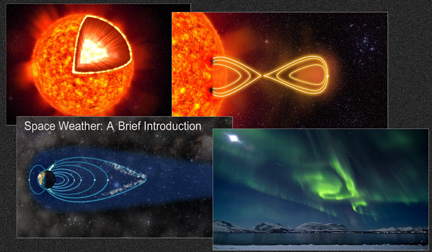
Also in Quicktime format: Large (269M) and Small ( 60M).
links
Space Weather links:
 Losts of interesting information
3-Day Forecast of Solar and Geophysical Activity
Space Weather overview
LASCO Coronagraph
Solar wind
Forecast discussion
Solar and Heliospheric Observatory (SOHO)
The Very Latest SOHO Images
Space Agencies:
European Space Agency (ESA)
Institute of Space and Astronautical Science (ISAS)
National Aeronautics and Space Administration (NASA)
Russian Space Agency
Credits:
Space Weather Images and Information (excluded from copyright) courtesy of:
NOAA / NWS Space Weather Prediction Center,
Mauna Loa Solar Observatory (HAO/NCAR),
and SOHO (ESA & NASA).
Équipement que nous utilisons:
Station de Météo |
Programme Météo |
|
|


1 user online | Contactez-nous | Valable HTML5 | Valable CSS
Ne prenez jamais des décisions importantes en vous basant sur des informations obtenues sur l'Internet
